
Showing posts with label education. Show all posts
Showing posts with label education. Show all posts
Tuesday, April 28, 2015
CoMotion Lecture Series Invite
You are welcome to join the CoMotion Incubator for one of these lectures led by students from the UW Entrepreneurial Law Clinic. Register HERE.


Friday, April 10, 2015

Tuesday, February 3, 2015
Techcrunch Disrupt-like Pitch Competition at NFTE’s StartUp Tech Expo
WHO: Witness young tech titans in the making! Network for Teaching Entrepreneurship will host its first ever StartUp Tech Expo with high school students from Tech Access Foundation, a STEM focused public school for students of color for grades 6-12.
WHAT/VISUAL: Experience first-hand the energy and innovation of the Techcrunch Disrupt-like Pitch Competition. Four teams will be given a few minutes to pitch their app idea to an audience filled with local business owners, executives, entrepreneurs, students and educators.
App ideas will include a sign language learning app, a real-time local natural disasters help and alert app, a STEM gaming tool and even an app that allows users to change battery draining settings on their phone, plus a prototype of a solar powered phone. Teams will be awarded a cash prize - winners will announced at the Expo.
WHEN: Thursday, February 5th
Crew Arrival: 11am Wrap: Noon
WHERE: Google Seattle Campus –
601 North 34th Street Seattle, WA 98103
WHY: The Pitch Competition and the Expo are the culmination of the StartUp Tech program – a pilot tech entrepreneurship program developing high school students entrepreneurship and coding skills which is running in four cities nationwide.
The event will also include a Q+A session with Googlers about what it’s like to work at the Internet product and services behemoth.
EXAMPLE: The award winning team of 7th graders, JSark Industries (the J is silent) had been working on their solar powered phone case prototype in their Engineering class with Mr. Diaz, founder of SODO Makerspace.
When the team entered the StartUp Tech Incubator this semester they learned how to add a software component to their hardware plans.
In addition to submitting their idea to the Verizon App Challenge in November, they also presented their concept at the TAF Academy STEM Pitch Event at Impact Hub Seattle.
Catch teammate, Ravi who’s starting a crowdfunding campaign at the Expo, with the hopes of travelling to the 11th International Fab Lab Conference & Symposium in Boston this summer.
WHAT/VISUAL: Experience first-hand the energy and innovation of the Techcrunch Disrupt-like Pitch Competition. Four teams will be given a few minutes to pitch their app idea to an audience filled with local business owners, executives, entrepreneurs, students and educators.
App ideas will include a sign language learning app, a real-time local natural disasters help and alert app, a STEM gaming tool and even an app that allows users to change battery draining settings on their phone, plus a prototype of a solar powered phone. Teams will be awarded a cash prize - winners will announced at the Expo.
WHEN: Thursday, February 5th
Crew Arrival: 11am Wrap: Noon
WHERE: Google Seattle Campus –
601 North 34th Street Seattle, WA 98103
WHY: The Pitch Competition and the Expo are the culmination of the StartUp Tech program – a pilot tech entrepreneurship program developing high school students entrepreneurship and coding skills which is running in four cities nationwide.
The event will also include a Q+A session with Googlers about what it’s like to work at the Internet product and services behemoth.
EXAMPLE: The award winning team of 7th graders, JSark Industries (the J is silent) had been working on their solar powered phone case prototype in their Engineering class with Mr. Diaz, founder of SODO Makerspace.
When the team entered the StartUp Tech Incubator this semester they learned how to add a software component to their hardware plans.
In addition to submitting their idea to the Verizon App Challenge in November, they also presented their concept at the TAF Academy STEM Pitch Event at Impact Hub Seattle.
Catch teammate, Ravi who’s starting a crowdfunding campaign at the Expo, with the hopes of travelling to the 11th International Fab Lab Conference & Symposium in Boston this summer.
Sunday, December 21, 2014
Robotics Leads to STEM
Robotics is a great way for students to immerse themselves in STEM (Science Technology Engineering Math).
Robotics clubs and classes from across the Bethel School District recently competed in Bethel's First Lego League Robotics Regional Competition which pitted 44 schools against each other. North Star Elementary and Frontier Middle School were two of the ten teams that will advance to the semifinals in January.
Students from North Star, Frontier, Graham Elementary, Bethel Middle and Thompson Elementary have starring roles in this video.
Robotics clubs and classes from across the Bethel School District recently competed in Bethel's First Lego League Robotics Regional Competition which pitted 44 schools against each other. North Star Elementary and Frontier Middle School were two of the ten teams that will advance to the semifinals in January.
Students from North Star, Frontier, Graham Elementary, Bethel Middle and Thompson Elementary have starring roles in this video.
Friday, May 23, 2014
$70,000 AWARDED TO STUDENT-LED STARTUPS
 Among those celebrating the teams’ achievements was keynote speaker Dan Price, CEO of Gravity Payments. Price, a BPC alum (he won the 2nd Place Prize in 2007) delivered an inspiring message, telling the teams that if they want to be successful, they should be true to themselves, continue learning and improving, and always be willing to roll up your sleeves, dive in, and get it done. Prices’ advice was taken to heart, especially by the winning teams, who will be using their seed funding to move their business a few steps closer to reality.
Congratulations to this year’s UW Business Plan Competition winners:
$25,000 Grand Prize: Projected Talent (UW) (Grand Prize sponsored by the Herbert B. Jones Foundation)
Projected Talent is an online marketplace that connects skilled undergrads to businesses on short, meaningful, paid projects. This allows students to gain valuable, relevant work experience and businesses to find and audition the best talent while accomplishing important tasks. By lowering the time, space and financial commitment, more companies than ever are now able to connect with students. Team: Samir Diwan, MBA, Foster School of Business; Bilal Aijazi, MS, UW Computer Science & Engineering; Julie Maas, MBA, Foster School of Business; Max Weissman, MBA, Foster School of Business; Jeff Shulman, nonstudent
$10,000 Second Place Prize (Second Place Prize sponsored by WRF Capital)
Flu Finder (UW) Current flu diagnostic tests are unable to achieve effective early diagnosis for most flu-infected individuals. Flu Finder has created a flu test that is accurate, inexpensive and can be administered by anyone, anywhere, with results in less than 20 minutes. Team: Carly Holstein, PhD, UW Bioengineering; Gina Fridley, PhD, UW Bioengineering; Alyssa Hochman, MBA, Foster School of Business; Jonny Holz, MBA, Foster School of Business; Joel Loveday, MBA, Foster School of Business
$7,520.14 Finalist Prize ($7,520.14 Finalist Prize sponsored by the Friends of the BPC)
OlyKraut (BGI) OlyKraut combines local produce, the magic of fermentation and delicious original recipes to create sauerkraut that's more than a condiment--it's a health tonic, a kick in the tastebuds and an investment in the local food system.Team: Sash Sunday, MBA, Bainbridge Graduate Institute; Michelle Anderson, MBA, Bainbridge Graduate Institute; Domonique Juleon, MBA, Bainbridge Graduate Institute; Dorothy Mitchell, MBA, Bainbridge Graduate Institute
$5,000 Finalist Prize: Korvata (UW) ($5,000 Finalist Prize sponsored by Wilson Sonsini Goodrich & Rosati)
Korvata Inc. creates cutting edge alternative chemistry products that enable companies to mitigate their environmental impact. Korvata, a Delaware Corporation, received the top award at the 2014 UW Environmental Innovation Challenge (EIC). Its patent-pending technology enables customers in the food & beverage and CPG industries to significantly reduce their carbon footprints.
Team: Chris Metcalfe, MBA, Foster School of Business; Soleil Kelley, MBA, Foster School of Business; Brendan Trickey, MBA, Foster School of Business; Devapratim Sarma, MBA, Foster School of Business; Taylor Brugh, MBA, Foster School of Business;
Best Idea Prizes
$2,500 Best Technology Idea (Best Technology Idea Prize sponsored by UIEvolution)
Aurora Plasmonics (University of Washington) Blood clots are a major problem during dialysis—an average of 400,000 de-clotting procedures take place each year in the U.S. Aurora Plasmonics has developed cost-effective, non-invasive therapeutic and diagnostic technologies for de-clotting procedures. These technologies offer reduced procedure times and costs, improved outcomes and increased patient comfort. Team: Michael Lombardo, Undergrad, UW Chemical Engineering; Thomas DeMaria, MBA, Foster School of Business; Jess Little, Undergrad, UW Chemical Engineering; Wayne Monsky, nonstudent; Rainie Nelson, Undergrad, UW Chemical Engineering
$2,500 Best Service/Retail Idea: (Best Service/Retail Prize sponsored by DLA Piper)
FastBar (UW Bothell) Everyone hates long bar lines, and payment processing at pop-up bars—temporary bars for special events that don't have built-in point of sale systems —can mean especially long wait times. FastBar provides a simple, high-speed payment solution for pop-up bars that uses RFID wrist bands. Team: David Goecke, Undergrad, UW Bothell Business; Chris Li, non student; Brenton Webster, non student
$2,500 Best Sustainable Advantage Idea (Best Sustainable Advantage Idea Prize sponsored by Sensors in Motion)
Mobile Foam (Washington State University) 1.6 billion people worldwide live in substandard housing. Humanitarian organizations are trying to address this by building more homes, but construction is often low-quality and lacks energy efficiency. Mobile Foam empowers humanitarian organizations to build higher quality homes with their building kit: floor-plans, consulting and the necessary chemicals and portable molds to produce polyurethane blocks on-site. Team: Chris Routen, Undergrad, WSU Mechanical Engineering; Dane Baird, Undergrad, WSU Mechanical Engineering; Austin Carter, Undergrad, WSU Marketing; Bettina Ernst, Undergrad, WSU Civil Engineering; Kelsi Lakey, Undergrad, WSU Computer Engineering
$2,500 Best Innovation Idea (Best Innovation Idea Prize sponsored by Perkins Coie)
Flu Finder (University of Washington) Current flu diagnostic tests are unable to achieve effective early diagnosis for most flu-infected individuals. Flu Finder has created a flu test that is accurate, inexpensive and can be administered by anyone, anywhere, with results in less than 20 minutes. Team: Carly Holstein, PhD, UW Bioengineering; Gina Fridley, PhD, UW Bioengineering; Alyssa Hochman, MBA, Foster School of Business; Jonny Holz, MBA, Foster School of Business; Joel Loveday, MBA, Foster School of Business
$2,500 Best Consumer Product Idea (Best Consumer Product Idea Prize sponsored by Accenture)
Trestle (University of Washington) Trestle converts your smart phone into a touchscreen interface for your Wi-Fi router. With Trestle, complicated configuration tasks are automated making your home network a breeze to set up and your Internet security and speed are continuously optimized. It's so easy that even your grandma can do it! Team: Kris Hunt, MBA, Foster School of Business; Matt Gryll, MBA, Foster School of Business; Aneesh Kulkarni, Grad, UW Computer Science & Engineering; Raj Makker, Grad, UW Computer Science & Engineering
$2,500 Best Cleantech Idea (Best Cleantech Idea Prize sponsored by Fenwick & West)
IonoMetal Technologies (University of Washington) Gold-plated surfaces used in computer chip testing wear down with repeated use and must be replaced. Each test board costs upwards of $40,000, and there is currently no available cost efficient repair option that satisfies industry standards. IonoMetal Technologies has developed technology that lowers the costs of manufacturing new gold-plated test boards by 10x. Team: Pritam Das, MBA, Foster School of Business; Trevor Braun, PhD, UW Chemical Engineering; Britton Stamper, Undergrad, UW Chemical Engineering; Alison Keeney, Undergrad, UW Chemical Engineering; Andrew Carlson, Undergrad, UW Chemical Engineering
$2,500 Best Marketplace Idea (Best Marketplace Idea Prize sponsored by eBay Enterprise)
Stash (University of Washington) Stash has created an affordable storage platform by connecting people who need storage to those who have extra space around their house or garage. Team: Katie Fraser, Undergrad, Foster School of Business; Aaron Goff, non student; Chris Goolsbee, non student; Robert Sanders, non student; Chad Robischo, non student
$5,000 AARP Prize for low-income senior service
FDCARES (University of Washington) Fire departments use up valuable time and money dispatching Emergency Medical Service in response to non-urgent 911 calls—up to 40% of fire department medical responses are for non-emergencies. FDCARES saves fire departments millions of dollars and improves their 911 response efficiency by integrating a Non-Emergency Medical Service division into their operations. Team: Adam Davis, UW Doctorate of Nursing Practice; Mitch Snyder, non student; Jim Webb, non student
CONTACT:
Ellen Pepin, Assistant Director, Buerk Center for Entrepreneurship, 206.616.3691
Monday, May 5, 2014
Congratulations to the 2014 UW Business Plan Competition Sweet 16
On April 29, 36 student-led startups from colleges and universities across Washington state gathered at the University of Washington to compete in the Investment Round of the annual UW Business Plan Competition.
This years’ teams, selected from a pool of 92 applicants, demonstrated innovation and inspiration across sectors—solar energy, wearable technology, public health and safety, even sauerkraut! After four hours of pitching to 300+ judges—entrepreneurs, lawyers, investors, and other top professionals—the sixteen top-scoring teams were announced. These teams will move on to the next round of the 2014 BPC, and a chance to win the $25,000 Grand Prize! Stay tuned.
Top Teams:
ChooseVets.com (University of Washington – Tacoma)
Outsource your life and empower a veteran. ChooseVets is a web based, peer-to-peer market through which customers can hire local military veterans to complete common or specialized tasks, jobs or errands. ChooseVets will charge a brokerage fee for connecting its customers with its military veteran independent contractors. ChooseVets' contractors can perform a diverse range of personal services and labor, ranging from landscaping to remodeling houses. Through ChooseVets, businesses and individuals can not only find reliable, skilled people to get needed tasks accomplished, they can show their support for America’s veterans and help them reintegrate back into their local communities.
Aurora Plasmonics (University of Washington)
Aurora Plasmonics has developed a new, non-invasive theranostic agent that allows for a new blood declotting procedure with simultaneous imaging capabilities.
FastBar (University of Washington - Bothell)
FastBar increases bar revenue and improves the attendee experience with a cashless RFID payment system designed for pop-up events.
FDCARES (University of Washington)
FDCARES, LLC is an evidence-based training, safety and quality assurance company dedicated to transforming and improving fire department services for non-emergency patient care. FDCARES supplies fire departments with products and services that optimize their medical response system for non-emergency 911 callers and high-volume users of Emergency Medical Services and Emergency Department care. The results are better care, fewer costs, and safer communities.
Flu Finder (University of Washington)
Current flu diagnostic tests are unable to achieve effective early diagnosis for most flu-¬infected individuals. Flu Finder has created a flu test that is accurate, inexpensive, and can be administered by anyone, anywhere, with results in less than 20 minutes.
Innovii (University of Washington)
The Innovii Challenge is a competition where teams of 3 to 5 high school students are given a twenty dollar bill and ten days to create, develop, and execute a profitable micro-venture.
IonoMetal Technologies (University of Washington)
With its revolutionary patented technology and demonstrated tool, Ionometals will not only make the earth a better place to live by reducing landfill of semiconductor waste, but also help save approximately $0.5MM for every semiconductor testing company.
Korvata (University of Washington)
Korvata Inc. creates cutting edge alternative chemistry products that enable companies to mitigate their environmental impact. Korvata, a Delaware Corporation, received the top award at the 2014 UW Environmental Innovation Challenge (EIC). Its patent-pending technology enables customers in the food & beverage and CPG industries to significantly reduce their carbon footprints.
Loopool (Bainbridge Graduate Institute)
Loopool is both a technology and a philosophy for the management of a sustainable textile and apparel supply chain ecosystem. It is a process used to reclaim textile and apparel waste and convert it into high quality bio-based fiber for the creation of new textiles and apparel. Loopool is a holistic closed-loop garment recycling system and a business model representative of the new era circular economy.
Mobile Foam (Washington State University)
Mobile Foam provides companies with the necessary chemicals and portable molds to manufacture polyurethane blocks, allowing for organizations to bypass shipping costs of individual blocks by manufacturing their own building materials on the site of construction. This method will allow organizations to construct houses in a faster, more cost effective manner, allowing for increased housing production rates while creating long lasting quality homes.
NOVA Technologies (Western Washington University)
As the thirst for energy increases, the world’s superpowers are becoming dangerously covetous. In desperation to stave the inevitable, the most pristine natural wonders are sacrificed in the name of progress. Pipelines, mines, fracking sites, nuclear deposits, and coal dust risk the stability of a delicate environment; yet we continue. Imagine if the entire surface area of a skyscraper could function as a solar system. Thousands of square feet of solar windows, entire buildings, entire cities generating localized power. NOVA Technologies is proud to present the very first fully transparent photovoltaic solar window: the NOVA Solar Window.
OlyKraut (Bainbridge Graduate Institute)
OlyKraut combines local produce, the magic of fermentation, and delicious original recipes to create sauerkraut that's more than a condiment--it's a health tonic, a kick in the tastebuds, and an investment in the local food system.
OpsMagic (University of Washington)
OpsMagic combines off-the-shelf cameras and advanced computer vision to automate observational studies, empowering businesses to tune operations to consumer demand. By building software intelligence and analytics on top of everyday video infrastructure, we solve the pain of a person using a stopwatch and some paper to measure business processes. Instead, we enable businesses to quickly understand customer demand, rapidly iterate on continuous improvements, and immediately see cause and effect. OpsMagic solves a major hassle in business operations measurement by tapping into new source of big data in video.
Projected Talent (University of Washington)
Projected Talent is revolutionizing the way that businesses hire student interns. It's online platform allows businesses to "audition" multiple candidates on short-term projects, avoiding the commitment of a long-term hire until they find the right fit. It also provides students with the opportunity to gain experience in a variety of fields by working on projects for a number of different companies.
Spectral DNA (University of Washington)
Spectral DNA's goal is to deliver a conformable solar fabric that can be fully integrated into a multi-use model for ubiquitous power generation. We aim to micro-design these 3D conformable fabrics into clothing, and other needed uses and applications for ubiquitous power. This can be used as a mobile power generation house without connecting to wires.
Trestle (University of Washington)
Trestle is the answer to the question "what would it look like if Nest built a router?" - our passion is simplifying the complicated process of setting up a wireless router and increasing network speeds by up to 10x, and our goal is delighting our customers with the most user friendly technological experience they've ever had. Trestle is hassle-free software to set up, secure and optimize your wireless network so easy that even your grandma can do it.
Alternates:
vHab (University of Washington)
vHab is a rehabilitation technology platform that allows clinicians to follow a stroke patient's recovery throughout the entire course of their treatment and adds a gamified patient environment that will improve recovery outcomes. Designed to be mobile and integrative, vHab aims to use advances in motion capture, electromyography, and virtual reality to engage the patient in a dynamic, gamified therapy environment while recording precision metrics and seamlessly reporting to their clinician.
Legato (University of Washington)
Legato is a convenient mobile application that provides an interactive speech therapy solution for children.
Want to know more?
• Follow the progress of the 2014 BPC on Twitter: #UWBPC2014
• Join in for the Final Round on Thursday, May 22, 1-4:30pm in Dempsey Hall.
This years’ teams, selected from a pool of 92 applicants, demonstrated innovation and inspiration across sectors—solar energy, wearable technology, public health and safety, even sauerkraut! After four hours of pitching to 300+ judges—entrepreneurs, lawyers, investors, and other top professionals—the sixteen top-scoring teams were announced. These teams will move on to the next round of the 2014 BPC, and a chance to win the $25,000 Grand Prize! Stay tuned.
Top Teams:
ChooseVets.com (University of Washington – Tacoma)
Outsource your life and empower a veteran. ChooseVets is a web based, peer-to-peer market through which customers can hire local military veterans to complete common or specialized tasks, jobs or errands. ChooseVets will charge a brokerage fee for connecting its customers with its military veteran independent contractors. ChooseVets' contractors can perform a diverse range of personal services and labor, ranging from landscaping to remodeling houses. Through ChooseVets, businesses and individuals can not only find reliable, skilled people to get needed tasks accomplished, they can show their support for America’s veterans and help them reintegrate back into their local communities.
Aurora Plasmonics (University of Washington)
Aurora Plasmonics has developed a new, non-invasive theranostic agent that allows for a new blood declotting procedure with simultaneous imaging capabilities.
FastBar (University of Washington - Bothell)
FastBar increases bar revenue and improves the attendee experience with a cashless RFID payment system designed for pop-up events.
FDCARES (University of Washington)
FDCARES, LLC is an evidence-based training, safety and quality assurance company dedicated to transforming and improving fire department services for non-emergency patient care. FDCARES supplies fire departments with products and services that optimize their medical response system for non-emergency 911 callers and high-volume users of Emergency Medical Services and Emergency Department care. The results are better care, fewer costs, and safer communities.
Flu Finder (University of Washington)
Current flu diagnostic tests are unable to achieve effective early diagnosis for most flu-¬infected individuals. Flu Finder has created a flu test that is accurate, inexpensive, and can be administered by anyone, anywhere, with results in less than 20 minutes.
Innovii (University of Washington)
The Innovii Challenge is a competition where teams of 3 to 5 high school students are given a twenty dollar bill and ten days to create, develop, and execute a profitable micro-venture.
IonoMetal Technologies (University of Washington)
With its revolutionary patented technology and demonstrated tool, Ionometals will not only make the earth a better place to live by reducing landfill of semiconductor waste, but also help save approximately $0.5MM for every semiconductor testing company.
Korvata (University of Washington)
Korvata Inc. creates cutting edge alternative chemistry products that enable companies to mitigate their environmental impact. Korvata, a Delaware Corporation, received the top award at the 2014 UW Environmental Innovation Challenge (EIC). Its patent-pending technology enables customers in the food & beverage and CPG industries to significantly reduce their carbon footprints.
Loopool (Bainbridge Graduate Institute)
Loopool is both a technology and a philosophy for the management of a sustainable textile and apparel supply chain ecosystem. It is a process used to reclaim textile and apparel waste and convert it into high quality bio-based fiber for the creation of new textiles and apparel. Loopool is a holistic closed-loop garment recycling system and a business model representative of the new era circular economy.
Mobile Foam (Washington State University)
Mobile Foam provides companies with the necessary chemicals and portable molds to manufacture polyurethane blocks, allowing for organizations to bypass shipping costs of individual blocks by manufacturing their own building materials on the site of construction. This method will allow organizations to construct houses in a faster, more cost effective manner, allowing for increased housing production rates while creating long lasting quality homes.
NOVA Technologies (Western Washington University)
As the thirst for energy increases, the world’s superpowers are becoming dangerously covetous. In desperation to stave the inevitable, the most pristine natural wonders are sacrificed in the name of progress. Pipelines, mines, fracking sites, nuclear deposits, and coal dust risk the stability of a delicate environment; yet we continue. Imagine if the entire surface area of a skyscraper could function as a solar system. Thousands of square feet of solar windows, entire buildings, entire cities generating localized power. NOVA Technologies is proud to present the very first fully transparent photovoltaic solar window: the NOVA Solar Window.
OlyKraut (Bainbridge Graduate Institute)
OlyKraut combines local produce, the magic of fermentation, and delicious original recipes to create sauerkraut that's more than a condiment--it's a health tonic, a kick in the tastebuds, and an investment in the local food system.
OpsMagic (University of Washington)
OpsMagic combines off-the-shelf cameras and advanced computer vision to automate observational studies, empowering businesses to tune operations to consumer demand. By building software intelligence and analytics on top of everyday video infrastructure, we solve the pain of a person using a stopwatch and some paper to measure business processes. Instead, we enable businesses to quickly understand customer demand, rapidly iterate on continuous improvements, and immediately see cause and effect. OpsMagic solves a major hassle in business operations measurement by tapping into new source of big data in video.
Projected Talent (University of Washington)
Projected Talent is revolutionizing the way that businesses hire student interns. It's online platform allows businesses to "audition" multiple candidates on short-term projects, avoiding the commitment of a long-term hire until they find the right fit. It also provides students with the opportunity to gain experience in a variety of fields by working on projects for a number of different companies.
Spectral DNA (University of Washington)
Spectral DNA's goal is to deliver a conformable solar fabric that can be fully integrated into a multi-use model for ubiquitous power generation. We aim to micro-design these 3D conformable fabrics into clothing, and other needed uses and applications for ubiquitous power. This can be used as a mobile power generation house without connecting to wires.
Trestle (University of Washington)
Trestle is the answer to the question "what would it look like if Nest built a router?" - our passion is simplifying the complicated process of setting up a wireless router and increasing network speeds by up to 10x, and our goal is delighting our customers with the most user friendly technological experience they've ever had. Trestle is hassle-free software to set up, secure and optimize your wireless network so easy that even your grandma can do it.
Alternates:
vHab (University of Washington)
vHab is a rehabilitation technology platform that allows clinicians to follow a stroke patient's recovery throughout the entire course of their treatment and adds a gamified patient environment that will improve recovery outcomes. Designed to be mobile and integrative, vHab aims to use advances in motion capture, electromyography, and virtual reality to engage the patient in a dynamic, gamified therapy environment while recording precision metrics and seamlessly reporting to their clinician.
Legato (University of Washington)
Legato is a convenient mobile application that provides an interactive speech therapy solution for children.
Want to know more?
• Follow the progress of the 2014 BPC on Twitter: #UWBPC2014
• Join in for the Final Round on Thursday, May 22, 1-4:30pm in Dempsey Hall.
Wednesday, September 18, 2013


Wednesday, May 9, 2012
New E-Commerce Educational Course to Start

Can adding an E-Commerce component or strengthening an existing E-Commerce model benefit your business? Could formal employee education on the subject be part of your solution?
If so, please contact Brian Dunnicliffe with the Keller Center for Corporate Learning of DeVry University for information on a brand new E-Commerce specific educational opportunity starting soon BDunnicliffe@devry.edu.
Tuesday, November 8, 2011
Cyber Monday Linkup: Tacoma's E-Commerce Forum
http://linkd.in/tUUElz
An opportunity to Explore E-Commerce in Tacoma
http://linkd.in/tUUElz
An opportunity to Explore E-Commerce in Tacoma
Join us for an exciting, engaging and educational Forum where an experienced panel of South Puget Sound E-Commerce leaders will lead a discussion on e-commerce and where it fits in local business today.
Whether you have an existing business or are a budding entrepreneur, you'll gain invaluable insights on how these companies grew their e-Commerce business, the challenges they've faced, lessons they've learned, and where they're going in the future.
The Forum will also explore what can be done to help incubate more e-business, e-jobs and e-educational resources in the Tacoma and South Sound area.
Sponsors include the Tacoma-Pierce Co. Chamber, Click! Network, and KLAY AM Radio. KLAY AM News/Talk Radio will broadcast and stream the discussion live.
E-commerce exhibitor displays will also be available during the Forum to help companies or entrepreneurs interested in ecomm with questions on security, logistics, connectivity, education, development, etc. The cost is just $300 and includes a significant radio promotion package the week prior (Thanksgiving week, including Black Friday!).
If you're interested in being an exhibitor, contact Bill Kaufmann at: Bill@KaufmannKreative.com or 253-572-5221
If you're interested in attending, please add a comment to this page or on Linkedin (see URL above) so we have a count.
Thanks, and we hope you can join us!
Thanks, and we hope you can join us!
When: November 28, 2011 at 4:00 PM - 6:00 PM
Where: William Factory Business Incubator, Tacoma
1423 E 29th St,
1423 E 29th St,
Tacoma, WA 98404
Tuesday, August 16, 2011

Thursday, September 2, 2010
Tacoma Has New Science Cafe
Pacific Science Center has announced a third Science Café, which will be located in Tacoma, Washington.
Science Cafés bring scientists face-to-face with the general public in the comfortable, lively atmosphere of a neighborhood cafe or pub All Science Cafés are free to the public, open to all ages and no science background is required!.
The evening begins with a brief presentation by a scientist, which kicks off an extended discussion session between the scientist and audience. Previous cafés have covered climate science, evolution and religion, robotics, and health care, just to name a few.
A partnership with KCTS-9 Public Television, the Tacoma Science Café will take place the first Thursday of each month at the famous Harmon Brewery in downtown Tacoma. The pub, known as "Tacoma's Downtown Gathering Place" will welcome local scientists and community to discuss current science topics from climate impacts in the Northwest to the science of chocolate.
"We are grateful to the Institute of Museum and Library Services for their generous grant that allows us to expand our Science Café program to the South Sound," says Meena Selvakumar, Acting Vice President for Strategic Programs at Pacific Science Center.
Science Cafés bring scientists face-to-face with the general public in the comfortable, lively atmosphere of a neighborhood café or pub. All Science Cafés are free to the public, open to all ages and no science background is required!
"People attend our science cafés for a variety of reasons," said Wendy Hansen, Ph.D., SCOPE Project Manager for Pacific Science Center. "But most are there to learn something new about current research and to ask questions of the speaker. The appeal of the cafés is that people get to learn about cutting edge research in a fun environment."
The new café will launch Thursday, November 4, at 7 p.m. at the Harmon Brewery in downtown Tacoma. Each Science Café begins with a local scientist presenting a backbone of science related to the night's topic, followed by a short break for table discussion and beverage refills. The highlight of the night is an extended question and answer session with the scientist.
The Harmon Brewery is located at 1938 Pacific Avenue, Tacoma, WA 98402
Want more science cafes? Click here.
Science Cafés bring scientists face-to-face with the general public in the comfortable, lively atmosphere of a neighborhood cafe or pub All Science Cafés are free to the public, open to all ages and no science background is required!.
The evening begins with a brief presentation by a scientist, which kicks off an extended discussion session between the scientist and audience. Previous cafés have covered climate science, evolution and religion, robotics, and health care, just to name a few.
A partnership with KCTS-9 Public Television, the Tacoma Science Café will take place the first Thursday of each month at the famous Harmon Brewery in downtown Tacoma. The pub, known as "Tacoma's Downtown Gathering Place" will welcome local scientists and community to discuss current science topics from climate impacts in the Northwest to the science of chocolate.
"We are grateful to the Institute of Museum and Library Services for their generous grant that allows us to expand our Science Café program to the South Sound," says Meena Selvakumar, Acting Vice President for Strategic Programs at Pacific Science Center.
Science Cafés bring scientists face-to-face with the general public in the comfortable, lively atmosphere of a neighborhood café or pub. All Science Cafés are free to the public, open to all ages and no science background is required!
"People attend our science cafés for a variety of reasons," said Wendy Hansen, Ph.D., SCOPE Project Manager for Pacific Science Center. "But most are there to learn something new about current research and to ask questions of the speaker. The appeal of the cafés is that people get to learn about cutting edge research in a fun environment."
The new café will launch Thursday, November 4, at 7 p.m. at the Harmon Brewery in downtown Tacoma. Each Science Café begins with a local scientist presenting a backbone of science related to the night's topic, followed by a short break for table discussion and beverage refills. The highlight of the night is an extended question and answer session with the scientist.
The Harmon Brewery is located at 1938 Pacific Avenue, Tacoma, WA 98402
Want more science cafes? Click here.
Friday, May 28, 2010
Winners! BPC 2010

It’s been a terrific Business Plan Competition this year.
There were a record 92 student teams from 15 universities apply to participate in the competition. Over 120 judges devoted a full week-end the beginning of April to screen that group down to 36 teams—and provide feedback. At the Investment Round in late April, those 36 teams pitched their hearts out to 205 judges in the HUB Ballroom—and 16 advanced to the next round. Yesterday the Sweet 16 teams made their full presentations to another set of judges. Six highly credible teams made it to the Final Round, where they presented to seven entrepreneur judges.
The next generation of start-ups are focused on recycled glass for building materials, windows that turn sunlight into energy, helping Korean students learn English, mobile payments, camera systems at mountain resorts to capture and share the activities of enthusiasts, devices for rapid quantitative immunoassays, measuring fat loss, and enhancing the wheelchair-bound person’s ability to walk, and a revolutionary enzyme that can mix with clay to build roads.
Thank to the judges, sponsors, volunteers, faculty, and our colleagues at Bainbridge Graduate Institute, Central Washington, Edmonds CC, Embry-Riddle, Gonzaga, North Seattle CC, Seattle Central CC, Seattle Pacific, Seattle University, University of Puget Sound, University of Washington, UW Bothell, UW Tacoma, Western Washington, and Washington State University.
It takes a community (and a region) to raise an entrepreneur!
$25,000 Herbert B. Jones Foundation Grand Prize: YongoPal, UW
A service for South Korean university students that allows them to practice conversational English with their American peers via webcam, and that also allows university students in America to profit from those interactions. Kyung Hee Yun, BA in Political Science; Jon Hickey, Master of Communication in Digital Media; Darien Brown and Daron Hall
$10,000 Bristlecone-Selamat Challenge Second Prize: Empowering Engineering Technologies, UW
EETech is developing a medical device called ExoWalk that utilizes patented ExoTendon technology to dramatically reduce the muscular force required to walk, enabling people with wheelchairs to stand up and walk their way to better qualities of life. Brian Glaister, PhD in Mechanical Engineering; Katie Mulholland, MS in Mechanical Engineering; Chie Kawahara; and Jason Schoen
$5,000 Fenwick & West Finalist Prize: Febris, WSU
Produces a point of care viral diagnostic, based on patented processes, that can detect a viral infection days before the subject manifests physical symptoms and becomes contagious. Jason Burt, MBA; Alice Lombard, DVM-Doctor of Veterinary Medicine; Andrew Lombard, MBA; and Michael Whittaker, MBA
$5,000 WRF Capital Finalist Prize: Emergent Detection, UW and UWT
Working to solve the worldwide obesity epidemic with its handheld device that immediately and directly measures personal fat loss in the home user. Eric Fogel, Eve MBA; Joel Gjuka, MBA -UWT; Keegan Hall, MBA -UWT; Amanda Mathes, Eve MBA
BEST IDEA PRIZES
The BEST IDEA prizes were created to reward teams in the Business Plan Competition for their exceptional work in several different categories. The teams receiving these prizes were selected by a special group of judges during the Investment Round. This year we gave away SIX $2,500 Best Idea Prizes.
OVP Venture Partners Best Technology Idea: Empowering Engineering Technologies, UW
EETech is developing a medical device called ExoWalk that utilizes patented ExoTendon technology to dramatically reduce the muscular force required to walk, enabling people with wheelchairs to stand up and walk their way to better qualities of life. Brian Glaister, PhD in Mechanical Engineering; Katie Mulholland, MS in Mechanical Engineering; Chie Kawahara; and Jason Schoen
Synapse Product Development Best Consumer Product Idea: Native Roots, WSU and U of Idaho
Positioned to become a major supplier of native plants, the breeding program currently has 40 native plant varieties in position to be patented with plant variety patents (PVPs). Kathryn Leonard, MBA - WSU; Casey Neumeyer, BS Agribusiness - U of Idaho; and Mac Reynolds
Perkins Coie Best Innovation Idea: GreenStone International, Seattle U
Has developed a revolutionary enzyme that when mixed and compacted with clay creates a durable, low cost, waterproof and environmentally friendly road with a lifespan of more than 15 years. James Spaulding, MBA; Heidi Han Yu, MBA; Emily Marshall, MBA; Ping Chee; John Craig; and Dick Polley
DLA Piper Best Service/Retail Idea: Snovision, UW and Seattle Central Community College
Automated camera systems for mountain resorts that allow their terrain park participants to capture, share and further enjoy their mountain experience at home through our online community. Rob Hammond, MBA; Jonas Harris, BA International Business; Josh Scotland, Undergrad Computer Science and Business; Scott Stucker, Associate of Applied Sciences in Graphic Design; Sterling Swigart, Undergrad Computer Science; Eli Rosenberg, MBA; and Robert Capogna
Sensors in Motion Best Sustainable Advantage Idea: WISErg, WSU
Will provide earth-friendly solutions to the growing problems of food waste disposal and energy consumption by offering a unique food-to-fuel solution to the nation's largest consumers, starting with Fortune 500 corporate campuses. Brandon Baker, Undergrad Business; Jaimee Jewell, Undergrad Business; Larry LeSueur; and Jose Lugo
Keeler Investments Best Clean-Tech Idea: EnVitrum, UW
Using the consumer glass waste stream to produce 100% recycled building materials and agricultural products. Serena Batten, TMMBA; Scott Coil, Eve MBA; Grant Marchelli, MS Mechanical Engineering; and Renuka Prabhakar, BS Mechanical Engineering
A special thanks to the sponsors of the 2010 Business Plan Competition!
Wednesday, April 15, 2009
The "S" in STEM Comes to the Foss
 Today marked "ground- breaking" for the Urban Waters project facility on the eastern shore of Foss Waterway.
A dazzling little display of science - with dignitaries pouring flasks of liquid into a bigger container of blue fluid, turning the solution within clear - utilized the miracles possible with science as a demonstration of promises with a new facility dedicated to the science of the environment commenced.
This positive development in our community is a dividend with the University of Washington Tacoma. The cooperative effort among the City of Tacoma, UWT, Port of Tacoma and Puget Sound Partnership, is a seminal event for our community.
Wednesday, March 25, 2009
What’s Online for Broadband Stimulus
The feds recently posted on the Federal Register information about the National Telecommunications and Information Administration (NTIA) and Department of Agriculture’s Rural Utilities Service plans for their allocation from the Stimulus Bill.
The NTIA was allocated $4.7 billion and the USDA $2.5 billion. The funds were expressly approved for “unserved” and “underserved” locations, but those terms remain undefined. Both agencies are looking for input to these definitions and other aspects NLT April 13.
Six public meetings were held, the last yesterday in D.C. Public comments still accepted.
A recent meeting of these agencies and the Federal Communications Commission produced these five goals:
1. Close the broadband gap in unserved and underserved areas
2. Leverage private investment
3. Create jobs
4. Upgrade connectivity to schools, libraries and other community anchor institutions
5. Stimulate broadband demand
The NTIA is instructed to allocate $250 million towards the Broadband Data Improvement Act for mapping and community initiatives, at least $200 million to expand public computer center capacity in libraries and community colleges and at least $250 million for programs encouraging broadband adoption.
An unusual feature of the allocation is $10 million for audits and oversight of all programs.
There will be at least one grant per state, made in three rounds. All allocations must be made by September 30, 2010.
Wednesday, February 25, 2009


Wednesday, February 11, 2009
TAN Presents Another Winner
 The TacomaAngel Network produced another winner with its follow on course for Due Diligence* after last November's Deal Making seminar. Again with the assistance of the Kauffman Foundation and serial entrepreneur Bill Payne, a full house at the UWT's William Philip Hall worked at making themselves better angel investors.
The all-day seminar sandwiched TAN's regular general membership forum where two companies were featured to the qualified investors. Seminar participants had the immediate opportunities to practice the classroom coursework.  After hearing the 15-minute tall-building elevator speeches of each company's spokesperson, 5-minute Q&A sessions delved into the heart of investment opportunities.
 After hearing the 15-minute tall-building elevator speeches of each company's spokesperson, 5-minute Q&A sessions delved into the heart of investment opportunities.
Then, the entrepreneurs retreated to display areas where the potential investors could follow up with earlier unasked questions, and finger the merchandise on display.
Angel groups in the western Washington area are beginning to do more things in collaboration. Larry Kopp, Co-Chair of TAN welcomed all registered attendees, and noted that half the seminar enrollees were from other angel organizations.
This example of a sharing of entrepreneurial training on a regional basis matches the database sharing among these same angel groups via their websites but as they also assist one another by opening sharing protocols.
* The Power of Angel Investing is a program of the Ewing Marion Kauffman Foundation and is presented by the Angel Capital Education Foundation
Wednesday, January 21, 2009
HIGH Tech in Gig Harbor
It is 10:11 am on Jan. 21, and the crowd in the Galaxy Gig Harbor theater complex are awed into silence by this announcement from Galaxy CEO, Frank Rimkus regarding the location of International Space Station Expedition 18.


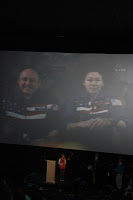
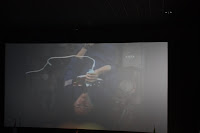
The still picture on the big screen in Theater 6 (capacity of 500 and where students from Peninsula School District are waiting in the wings to ask their questions of astronauts Mike Fincke and Sandra Magnus) flicks over to live feed video of the ground station responsible for actually doing the hooking up, and we’re off to a running start.
Kareen Borders, by all accounts THE person responsible for making this historic event happen by “bugging NASA until they gave in,” and Key Peninsula Middle School science teacher, addresses attendees in several theaters on each of their respective screens. She praises this partnership between business and education as bringing badly-needed cutting-edge technological achievement to students—opening their eyes to the world of science and hopefully to all that can be achieved through it. Including jobs that might not even exist yet.
When a disembodied voice announces that they are ready, the screens fill with the visages of Mike and Sandra in their royal blue uniforms emblazoned with the American flag and floating, bouncing—Sandra’s brown hair sticking up all around her head. We are mesmerized as we realize, Hey! They are in space! An appreciative murmur could be heard as Mike says they are “ready” the same time Kareen Borders thanks them. Little bit of a time lag between the theater and the space station but surprisingly not a time lag between Mike and Sandra and us as their mouth movements coincide with the audio.
Questions ranged from What is it like to sleep? Mike: We sleep in a sleeping bag that’s tethered down—that’s important, to “What are the effects on a human body staying in space so long?, Sandra: Calcium leaks out of our bones…similar to osteoporosis…we counter the effects through ingestion of calcium and exercise, to a thought-provoking question, How do you get resistance to use for exercising [due to lack of gravity]?, Sandra: Pulling against a vacuum [one of a few machines that helps].
There were at least a dozen kids who asked questions—sometimes relaying questions from kids from out of state and a few technologically science-savvy questions that had us adults scratching our heads.
The light bouncing and floating (and Sandra’s hair) were a little disconcerting to watch at first, but with Mike doing somersaults and sipping juice (letting fly a couple of big droplets that he then gobbled up mid-air), he entertained the crowd while Sandra answered questions.
At one point Sandra pointed out that they were basically human guinea pigs (which they were happy to be, don’t-get-her-wrong) to gauge how humans fare long-term in outer space and collecting all the data that would help for future long-term endeavors to the moon or even, Mars. As Mike put it, How much do we really need to survive or better yet, how little?
They have already learned how to make oxygen, recycle their urine, and harness solar energy for all their energy needs.
The astronauts were clearly enjoying themselves and the audience even more so as we caught a glimpse of life in outer space via Sandra’s and Mike’s answers.
As the downlink winded down and the astronauts waved their final goodbyes, there was a feeling that something magically momentous just happened.
Galaxy CEO Frank Rimkus then reiterated that even though there have been downlinks happening since 2001, with only a few in the last two years, this was the first time that it happened between the private sector and public education. He was proud that they were able to offer an educational entity the use of the state-of-the-art equipment that their Galaxy Uptown theater provided and to which most schools don’t have access to. He thanked the local Rotary Clubs for getting together funding to bus the students and acknowledged the presence of representatives from the Gates Foundation, the Paul G. Allen Foundation, the Russell Foundation, and the President of Washington Roundtable. Contingents from McChord AFB, Fort Lewis and Bremerton’s naval community were present as well as representatives for Gov. Gregoire and Sen. Derek Kilmer, whom Rimkus also acknowledged.
But ultimately, it was the presence of the students themselves that brought energy and purpose to such an event, and thanks to the formation of community and business partnerships, they were given an opportunity to embark on the right road in their journey to compete in a global workforce.


Going at a rate of 17,500 miles per hour, I think they are over the South Pacific right now…


The still picture on the big screen in Theater 6 (capacity of 500 and where students from Peninsula School District are waiting in the wings to ask their questions of astronauts Mike Fincke and Sandra Magnus) flicks over to live feed video of the ground station responsible for actually doing the hooking up, and we’re off to a running start.
Kareen Borders, by all accounts THE person responsible for making this historic event happen by “bugging NASA until they gave in,” and Key Peninsula Middle School science teacher, addresses attendees in several theaters on each of their respective screens. She praises this partnership between business and education as bringing badly-needed cutting-edge technological achievement to students—opening their eyes to the world of science and hopefully to all that can be achieved through it. Including jobs that might not even exist yet.
When a disembodied voice announces that they are ready, the screens fill with the visages of Mike and Sandra in their royal blue uniforms emblazoned with the American flag and floating, bouncing—Sandra’s brown hair sticking up all around her head. We are mesmerized as we realize, Hey! They are in space! An appreciative murmur could be heard as Mike says they are “ready” the same time Kareen Borders thanks them. Little bit of a time lag between the theater and the space station but surprisingly not a time lag between Mike and Sandra and us as their mouth movements coincide with the audio.
Questions ranged from What is it like to sleep? Mike: We sleep in a sleeping bag that’s tethered down—that’s important, to “What are the effects on a human body staying in space so long?, Sandra: Calcium leaks out of our bones…similar to osteoporosis…we counter the effects through ingestion of calcium and exercise, to a thought-provoking question, How do you get resistance to use for exercising [due to lack of gravity]?, Sandra: Pulling against a vacuum [one of a few machines that helps].
There were at least a dozen kids who asked questions—sometimes relaying questions from kids from out of state and a few technologically science-savvy questions that had us adults scratching our heads.
The light bouncing and floating (and Sandra’s hair) were a little disconcerting to watch at first, but with Mike doing somersaults and sipping juice (letting fly a couple of big droplets that he then gobbled up mid-air), he entertained the crowd while Sandra answered questions.
At one point Sandra pointed out that they were basically human guinea pigs (which they were happy to be, don’t-get-her-wrong) to gauge how humans fare long-term in outer space and collecting all the data that would help for future long-term endeavors to the moon or even, Mars. As Mike put it, How much do we really need to survive or better yet, how little?
They have already learned how to make oxygen, recycle their urine, and harness solar energy for all their energy needs.
The astronauts were clearly enjoying themselves and the audience even more so as we caught a glimpse of life in outer space via Sandra’s and Mike’s answers.
As the downlink winded down and the astronauts waved their final goodbyes, there was a feeling that something magically momentous just happened.
Galaxy CEO Frank Rimkus then reiterated that even though there have been downlinks happening since 2001, with only a few in the last two years, this was the first time that it happened between the private sector and public education. He was proud that they were able to offer an educational entity the use of the state-of-the-art equipment that their Galaxy Uptown theater provided and to which most schools don’t have access to. He thanked the local Rotary Clubs for getting together funding to bus the students and acknowledged the presence of representatives from the Gates Foundation, the Paul G. Allen Foundation, the Russell Foundation, and the President of Washington Roundtable. Contingents from McChord AFB, Fort Lewis and Bremerton’s naval community were present as well as representatives for Gov. Gregoire and Sen. Derek Kilmer, whom Rimkus also acknowledged.
But ultimately, it was the presence of the students themselves that brought energy and purpose to such an event, and thanks to the formation of community and business partnerships, they were given an opportunity to embark on the right road in their journey to compete in a global workforce.


Guest Author: Mimi Jansen, Communications Coordinator
Tacooma-Pierce Co. Chamber
Subscribe to:
Posts (Atom)


 Posts
Posts

